

The Priory
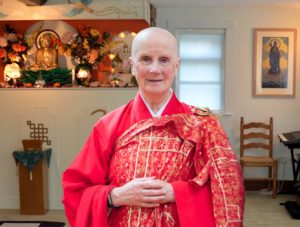
Telford Buddhist Priory is under the spiritual direction of the Prior, Rev. Mugō White, a disciple of the late Rev. Master Jiyu-Kennett, founder of The Order of Buddhist Contemplatives and Telford Buddhist Priory.
The purpose of spiritual practice is to realize our true nature, which is also the true nature of all existence, and to express this realization through body, speech, and mind. Through meditation and daily training, we learn to recognize and let go of the clinging that gives rise to suffering. As this clinging falls away, the love, compassion and wisdom inherent in our hearts are able to naturally unfold, enriching our lives and our relationships with others.
Sōtō Zen
Buddhism was founded over 2,500 years ago in northern India by Buddha Shakyamuni. As Buddhism spread across Asia, many different forms emerged, shaped by the character of individual teachers and the cultures through which the teachings passed. The form of Mahayana Buddhism known as Zen developed as a distinct school in China around the 8th century.
Our tradition, Sōtō Zen, was introduced to Japan in the 13th century by the Great Master Dōgen. Within the Sōtō Zen school there are many teaching lineages, each with its own particular flavour. Zen literally means “meditation,” and zazen—seated meditation—is the heart of our practice.
According to Buddhist teaching, all beings already possess the same enlightened nature as the Buddha. However, we obscure this by believing ourselves to be separate and isolated individuals. From this belief arises a sense of lack, and we spend our lives attempting to fill an inner void through possessions, power, or relationships. Yet no matter how much we acquire, the sense of insufficiency remains. From a Buddhist perspective, this suffering arises from a misunderstanding of our true nature.
The practice of zazen is the practice of learning to see beyond thoughts and feelings and to realize this true nature directly. There is a deep sufficiency within each of us, along with a vast capacity to give. The qualities of wisdom, compassion, and all the fruits of enlightenment are already present, but they can only be expressed when we see through our mistaken perceptions. This is not a matter of gaining something new, but of discovering what has always been here.
This way of practice is both affirming and challenging. It asks us to meet the present moment fully—excluding nothing and grasping nothing. As we develop the willingness to see ourselves as we are, without judgment, we gradually learn neither to indulge nor suppress our emotions. In doing so, we free ourselves from the forces that lead us to act unwisely. Compassion, for oneself and for all beings, lies at the very heart of this process.
Our Founder and the Order
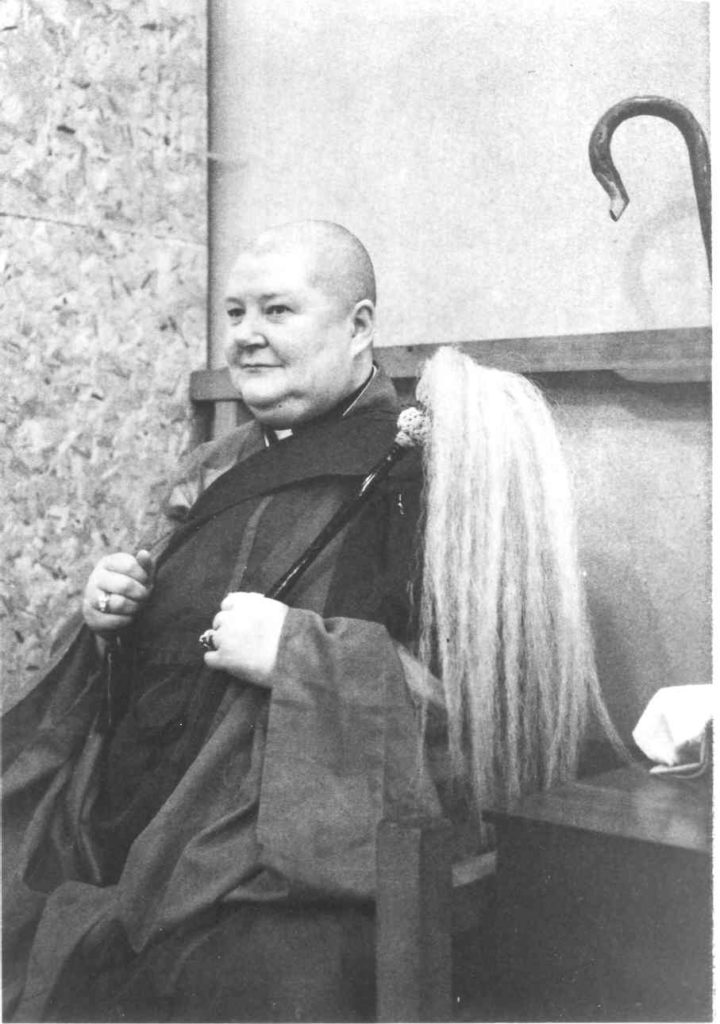
The founder of the Priory, Rev. Master Jiyu-Kennett, was an English woman who was ordained in Malaysia in the Chinese Buddhist tradition and then went on to study in Japan where she eventually became a Rōshi, or master, and was authorised to teach and to ordain men and women as monastics.
Those of us in the West who follow Sōtō Zen as passed on by Rev. Master Jiyu describe ourselves as the Serene Reflection Meditation tradition, and our monastic Sangha and lay ministers together comprise the Order of Buddhist Contemplatives.
The style of teaching used at the Priory has its roots firmly in the Zen tradition and yet has a form that, over the last forty-plus years, has been adapted to the needs of Western people. In the Order of Buddhist Contemplatives, men and women train together and have equal status and recognition. All ranks and both sexes are addressed as ‘Reverend’ and are referred to as monks and priests. Members of the monastic order are celibate.